
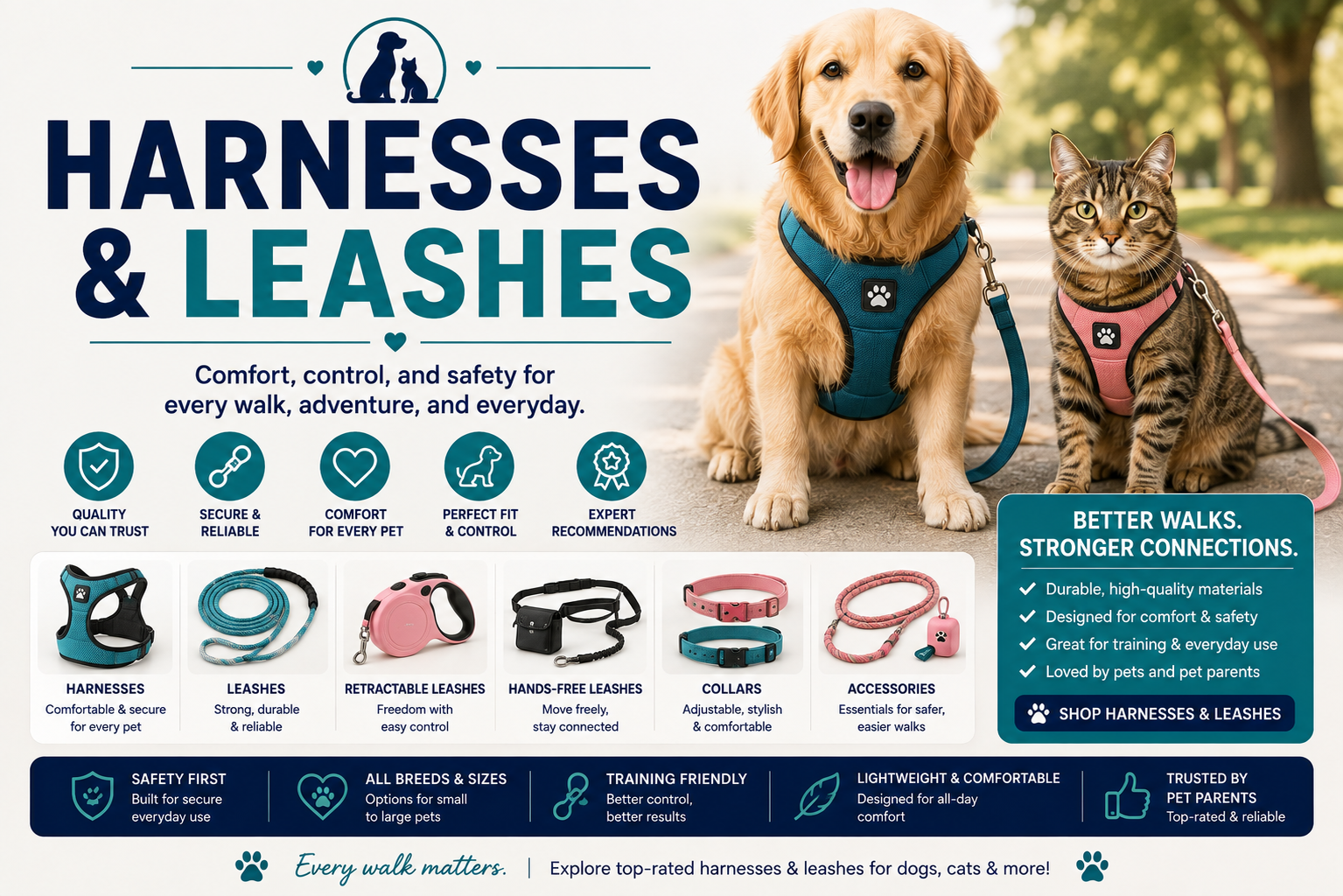
Harness vs Collar for Dogs
Compare Harness vs Collar for Dogs across features, comfort, durability, price and ideal use to decide which option better fits your pet and routine.
Quick Answer
Use a collar primarily for identification and light everyday handling when the dog walks without pulling. Use a well-fitted harness when you need broader force distribution, more control, reduced neck pressure, or support for walking, hiking, or travel.
Harness vs Collar for Dogs — products that make the differences concrete
Use these current products and product families to see how the tradeoffs discussed in this comparison show up in real buying choices.
Ruffwear Front Range Harness
Padded everyday design with front and back leash attachment options.
CHECK CURRENT PRICESKurgo Tru-Fit Smart Harness
Walking harness with vehicle-restraint compatibility in the same system.
CHECK CURRENT PRICESPetSafe Easy Walk Harness
Front attachment design intended to reduce pulling leverage.
CHECK CURRENT PRICESBlue-9 Balance Harness
Multiple adjustment points help fine-tune fit across different dog builds.
CHECK CURRENT PRICESHarness vs Collar for Dogs comparison
| Product / family | Best for | Why compare it | What to verify | Action |
|---|---|---|---|---|
| Ruffwear Front Range Harness | Best all-around everyday harness | Padded everyday design with front and back leash attachment options. | Measure chest girth carefully and check shoulder/elbow clearance; a good model can still fit the wrong dog poorly. | CHECK PRICES |
| Kurgo Tru-Fit Smart Harness | Best for car-and-walk versatility | Walking harness with vehicle-restraint compatibility in the same system. | Measure chest girth carefully and check shoulder/elbow clearance; a good model can still fit the wrong dog poorly. | CHECK PRICES |
| PetSafe Easy Walk Harness | Best for front-clip control | Front attachment design intended to reduce pulling leverage. | Measure chest girth carefully and check shoulder/elbow clearance; a good model can still fit the wrong dog poorly. | CHECK PRICES |
| Blue-9 Balance Harness | Best for adjustability | Multiple adjustment points help fine-tune fit across different dog builds. | Measure chest girth carefully and check shoulder/elbow clearance; a good model can still fit the wrong dog poorly. | CHECK PRICES |
Which option fits which buyer?
Ruffwear Front Range Harness
Padded everyday design with front and back leash attachment options.
Before buying: Measure chest girth carefully and check shoulder/elbow clearance; a good model can still fit the wrong dog poorly.
Kurgo Tru-Fit Smart Harness
Walking harness with vehicle-restraint compatibility in the same system.
Before buying: Measure chest girth carefully and check shoulder/elbow clearance; a good model can still fit the wrong dog poorly.
PetSafe Easy Walk Harness
Front attachment design intended to reduce pulling leverage.
Before buying: Measure chest girth carefully and check shoulder/elbow clearance; a good model can still fit the wrong dog poorly.
Blue-9 Balance Harness
Multiple adjustment points help fine-tune fit across different dog builds.
Before buying: Measure chest girth carefully and check shoulder/elbow clearance; a good model can still fit the wrong dog poorly.
Browse Harness vs Collar for Dogs
Review current options, then use the side-by-side criteria below to choose for the real pet, household, and routine.
Open the approved comparison search.
Compare Current OptionsWhich One Should You Choose?
Choose a harness for
Dogs that pull, have respiratory or neck concerns, need lifting support, or require more body control.
Choose a collar for
ID tags, short handling, and dogs that walk calmly without sustained leash pressure.
Use both thoughtfully
Many dogs wear a collar for identification and a harness for leash attachment.
Harness vs Collar
- Harness: Dogs that pull, have respiratory or neck concerns, need lifting support, or require more body control.
- Collar: ID tags, short handling, and dogs that walk calmly without sustained leash pressure.
- Pet fit: Measurements, behavior, and health matter more than labels.
- Maintenance: Compare cleaning, replacement parts, and failure points.
- Transition: Introduce unfamiliar equipment gradually.
Feature and Use-Case Comparison
| Category | Harness | Collar | Decision check |
|---|---|---|---|
| Force distribution | Across chest and torso | Concentrated around the neck | Match this difference to the real pet and use case. |
| Best use | Walking control, pulling management, support | Identification and calm leash walking | Match this difference to the real pet and use case. |
| Escape risk | Depends on body fit and adjustment | Depends on neck and head shape | Match this difference to the real pet and use case. |
| Common limitation | Can rub or restrict shoulders if poorly fitted | Can strain the neck when the dog pulls | Match this difference to the real pet and use case. |
How the Differences Affect the Purchase
1. Force distribution
Harness: Across chest and torso Collar: Concentrated around the neck
2. Best use
Harness: Walking control, pulling management, support Collar: Identification and calm leash walking
3. Escape risk
Harness: Depends on body fit and adjustment Collar: Depends on neck and head shape
4. Common limitation
Harness: Can rub or restrict shoulders if poorly fitted Collar: Can strain the neck when the dog pulls
Important Limitations
A harness does not automatically stop pulling without training.
A collar should not be used to apply repeated corrections or sustained pressure.
Either product can fail if it is loose, damaged, or incorrectly sized.
Harness vs Collar for Dogs FAQs
Which is better overall: Harness or Collar?
Use a collar primarily for identification and light everyday handling when the dog walks without pulling. Use a well-fitted harness when you need broader force distribution, more control, reduced neck pressure, or support for walking, hiking, or travel.
When should I choose Harness?
Dogs that pull, have respiratory or neck concerns, need lifting support, or require more body control.
When should I choose Collar?
ID tags, short handling, and dogs that walk calmly without sustained leash pressure.
Which option is easier to maintain?
Maintenance depends on materials, moving parts, food or waste contact, and how often the product is used. Simpler designs usually have fewer failure points, while automated or specialized products may reduce one task but add others.
Are the two options interchangeable?
Not always. Fit, intended use, accessories, power requirements, training needs, and safety limitations can differ substantially.
What should I verify before buying?
Confirm current specifications, dimensions, pet eligibility, setup requirements, cleaning, and compatibility with the individual pet and household.
How should the new product be introduced?
Introduce it gradually in a calm setting. Allow investigation, reward voluntary use, and keep the previous familiar option available when practical.
When should the product be replaced?
Replace it after cracks, fraying, failed fasteners, damaged electronics, exposed foam, sharp edges, persistent odor, or any condition that prevents safe cleaning or use.
Choose by Use Case, Not Labels
Match the exact product to the pet, environment, setup, and maintenance commitment.
See Current SelectionKEEP EXPLORING
Related guides and comparisons
Use these closely related PetSupplyGuide resources to compare options, understand fit and make the next buying decision with better context.