
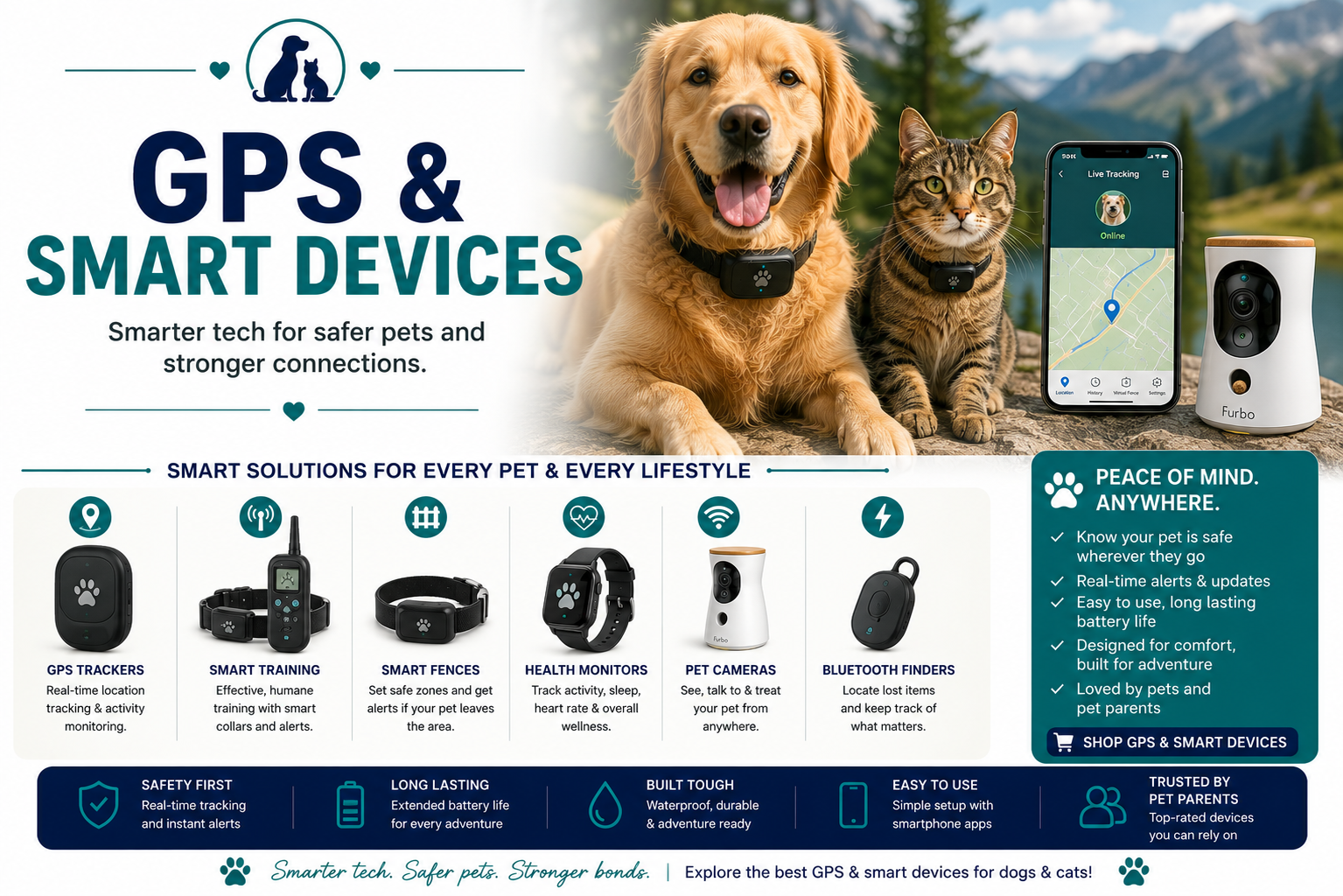
Pet GPS Trackers
Explore pet gps trackers with buying guides, product comparisons, sizing help, safety advice and practical recommendations for pet owners.
Quick Answer
A pet GPS tracker should be light enough for the collar, compatible with local cellular coverage, resistant to normal weather exposure, and supported by a realistic charging routine. It is a recovery aid, not a substitute for identification, secure containment, or supervision.
Browse Pet GPS Trackers
Review the current selection, then use the fit, safety, handling, maintenance, and compatibility guidance below to narrow the choices.
Open the approved category search in a new tab.
View Available OptionsMain Types and Use Cases
Start with the product format that fits the pet, handler, environment, and task rather than choosing by appearance alone.
Cellular GPS tracker
Uses satellite positioning and mobile data for broad-area location updates.
Coverage, subscription, and update frequencyRadio-frequency tracker
Communicates directly with a handheld receiver without cellular service.
Range and terrain performanceBluetooth item finder
Relies on nearby phones or short-range Bluetooth rather than continuous pet GPS.
Network density and attachment securityActivity-enabled tracker
Combines location functions with movement or rest estimates.
Location reliability should remain the primary criterionWhat Matters Most
- Coverage: Confirm the network and service work where the pet normally travels.
- Attachment: The mount should remain secure without creating a snagging hazard.
- Battery routine: Real-world usefulness depends on regular charging and low-battery alerts.
- Water resistance: Match the stated rating to rain, swimming, and cleaning exposure.
- App controls: Review geofence alerts, update intervals, sharing, and account security.
Compare the Main Formats
Use this framework to identify the configuration that best matches the intended routine.
| Format | Best use | Feature to prioritize | Important check |
|---|---|---|---|
| Cellular GPS tracker | Uses satellite positioning and mobile data for broad-area location updates. | Coverage, subscription, and update frequency | Match the product to the individual pet and intended setting. |
| Radio-frequency tracker | Communicates directly with a handheld receiver without cellular service. | Range and terrain performance | Match the product to the individual pet and intended setting. |
| Bluetooth item finder | Relies on nearby phones or short-range Bluetooth rather than continuous pet GPS. | Network density and attachment security | Match the product to the individual pet and intended setting. |
| Activity-enabled tracker | Combines location functions with movement or rest estimates. | Location reliability should remain the primary criterion | Match the product to the individual pet and intended setting. |
How to Choose and Use It Safely
A careful setup and gradual introduction usually matter as much as the product itself.
1. Verify service coverage
Check the provider’s supported country, carrier, and network requirements.
2. Fit the device
Keep the tracker secure and balanced without interfering with collar fit or movement.
3. Configure alerts
Set practical safe zones and test notifications before relying on them.
4. Perform a field test
Walk the tracker through familiar routes and verify map updates and recovery directions.
5. Create a charging habit
Recharge before low levels and inspect the port, contacts, or dock.
6. Maintain backup ID
Use a readable tag and permanent identification such as a microchip where appropriate.
Common Buying and Use Mistakes
Buying without checking subscription requirements or local network compatibility.
Treating an item finder as equivalent to an independent cellular GPS tracker.
Depending on geofence alerts while ignoring collar attachment and secure physical containment.
Related approved resources include Best GPS Dog Trackers How GPS Dog Trackers Work How to Choose a Cat GPS Tracker.
Pet GPS Trackers FAQs
Does a pet GPS tracker work without cellular service?
Cellular models generally need supported network coverage to transmit location to the app. Radio trackers can work without cellular service but have their own range limits.
Is a subscription always required?
Many cellular trackers require a service plan, while radio devices and some item finders do not. Confirm the ongoing requirements before purchase.
Can an AirTag replace a pet GPS tracker?
Item finders use different technology and are not the same as continuous cellular pet GPS. Their performance depends heavily on nearby compatible devices.
How accurate are pet trackers?
Accuracy varies with satellite view, buildings, terrain, network conditions, and update settings. Test the device in the places where it will actually be used.
How long does the battery last?
Runtime depends on device size, signal conditions, update frequency, and activity. Use the manufacturer’s range as a planning guide and establish a charging routine.
Are GPS trackers waterproof?
Ratings differ. Check the exact water-resistance specification and whether it covers rain, splashes, or immersion.
Should a tracker replace a microchip?
No. A tracker can be lost, damaged, or discharged. Permanent identification and a visible tag remain important.
How secure should the tracker mount be?
It should resist normal running and play while avoiding sharp edges, excessive weight, and configurations likely to snag.
Choose Pet GPS Trackers for the Real Routine
Match the product to the pet, setting, handling plan, and maintenance commitment before deciding.
See Current Selection